Architects Don't Just Build Software — Their Greater Impact Lies in How Software Gets Built
This distinction defines the architect’s most strategic and value-adding impact.
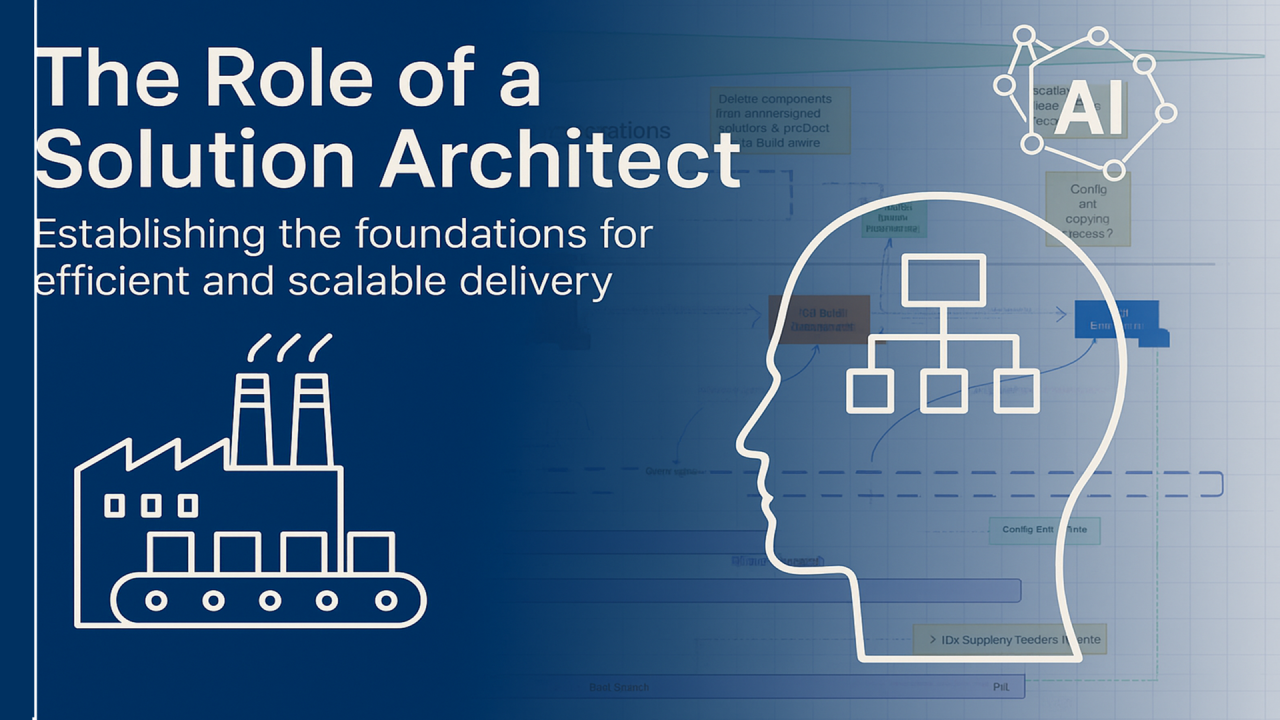
The Role of a Solution Architect: Designing the Factory Before the Assembly Begins
In software development, the role of a solution architect isn’t centered on day-to-day implementation — it’s about establishing the foundations that make ongoing delivery efficient, scalable, and resilient.
Take automobile manufacturing as an analogy: highly skilled professionals — and increasingly, robots — operate on the assembly line to perform critical, timed tasks. But before a single vehicle is assembled, someone has to design the entire system: the layout of conveyor belts, the sequencing of stations, the flow of materials, and the integration of quality checks.
That’s the essence of what architects do in technology. They don’t build the car — they design the factory that builds the car.
In an Agile SDLC, architects engage early to shape how ideas evolve into solutions — defining the structure for how software is envisioned, built, tested, deployed, and maintained. They factor in stakeholder expectations, technical constraints, and long-term adaptability — while ensuring that automation, governance, and scalability are deliberately embedded into the delivery lifecycle.
Whether it’s enabling ALM strategies (aka CI/CD pipelines), aligning modular architectures with shifting priorities, or laying the groundwork for cross-team collaboration — architectural thinking focuses on building ecosystems that empower sustainable, high-velocity delivery.
A punchline of this story also is that architects are “not always liked” due to the discipline they have to setup and keep maintained across the delivery !!!
Architectural thinking demands the ability to operate at multiple levels of abstraction — zooming in to conceptualize modular components and zooming out to align with enterprise-wide objectives. This isn’t just a skill, it’s a necessity. Architects must hold a clear view of the holistic landscape — spanning people, processes, platforms, and policies — while making decisions that remain adaptable, interoperable, and future-ready. It’s this dual mindset that ensures the architecture not only solves today’s problems but enables tomorrow’s innovation.
As AI and autonomous agents continue to evolve, many organizational leaders are beginning to question whether architectural thinking can be delegated — or even replaced — by intelligent systems. While AI can certainly support design tasks, surface patterns, and optimize known variables, the role of a solution architect remains deeply human: navigating ambiguity, aligning diverse stakeholders, and making trade-offs that balance technology with business context. Architecture isn’t just logic — it’s judgment, foresight, and systems thinking rooted in experience.
It may not be visible in sprint backlogs, but the absence of this foundational work can compromise the integrity of the entire delivery pipeline.